Strong Magnetic Sheets for Wall Storage: My Remote Finally Stays Put
My air conditioner remote kept sliding down when I mounted it with a cheap magnetic sheet. Switching to Kokuyo’s stronger magnetic plates solved it. A small change, but a very satisfying one.
I live in Japan, where flexible magnetic sheets turn up everywhere: on school blackboards, office whiteboards, and staff attendance boards with little magnetic name labels.
They also look ideal for sticking a remote somewhere convenient. Until the batteries add just enough weight to send it slowly creeping toward the floor.
Strong enough to snap onto a steel surface

The magnetic sheets I bought at Seria couldn’t keep my air conditioner remote in place, even with just two AAA batteries inside. Seria is one of Japan’s 100-yen shops, roughly the equivalent of a dollar store. Magnets are easy to find there, but the thin sheets I tried all seemed similarly weak.
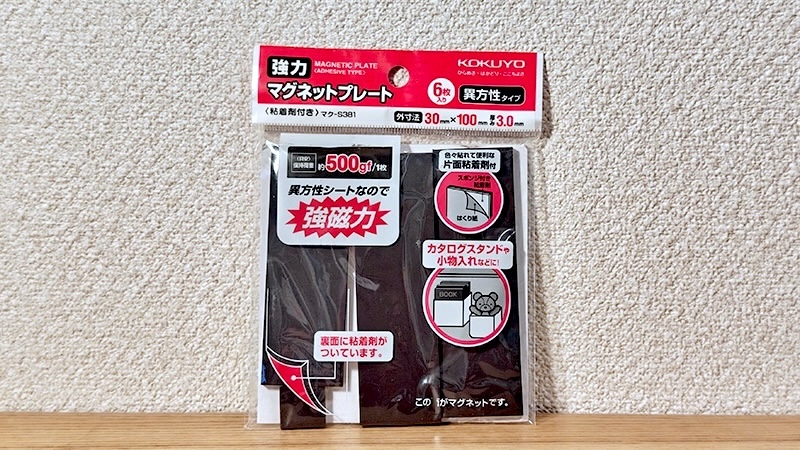
So I spent a bit more on Kokuyo’s strong magnetic plates, model マク-S381. They grab steel with the satisfying snap I associate with a neodymium magnet. That’s a comparison of how they feel to use, rather than a claim about what they’re made of.
Bring a full strip near a suitable steel surface—a whiteboard, for example—and it attaches with a definite clack.
The pack contains six strips. For my air conditioner remote, about half a strip was enough. It stays where I put it and doesn’t shift when I accidentally knock it lightly. That was all I wanted from the cheaper sheets in the first place.
How do you mount a magnetic remote on an ordinary wall?

A suitable steel refrigerator door is convenient. Unfortunately, my preferred remote-control spot isn’t conveniently made of steel.
The other half of the setup is a small adhesive-backed steel mounting plate. The magnet goes on the remote; the steel plate goes on the wall. The mounting plate itself doesn’t need to be a magnet.
These plates are sold in Japanese 100-yen shops too, although buying a pack online can make more sense depending on the size and quantity needed. The product linked above is one example sold in Japan.
It’s an extremely simple idea: a piece of metal with double-sided adhesive on the back. Sometimes simple is exactly what I want.
At home, the wall-mounted plate has stayed in place while I remove and replace the remote. My setup in our Japanese-style room has been fine for about four years. That’s my experience with the mounting setup, rather than a four-year test of the particular product linked above.
For anyone trying something similar, here’s the basic sequence:
- Check that the intended surface is suitable for the mounting plate’s adhesive.
- Attach the magnetic strip to the remote and the steel plate to the wall, following their instructions.
- Test the hold with the actual object before relying on it.
- Remember that wallpaper and paint can be damaged when adhesive is removed.
Why use a magnetic sheet instead of a hard rectangular magnet?
Some inexpensive magnetic accessories already contain a small, hard black magnet, often held in a steel bracket. If I had a suitable spare one, attaching it to the remote could be another option.
The Kokuyo strips are useful because I can choose how much of a strip to use. They’re 3 mm thick, so these aren’t the flimsy sheets I originally imagined.
Kokuyo lists the strips as 30 × 100 × 3 mm, with an approximate holding load of 500 g per strip. That is a guide for the product, rather than a guarantee for every wall-storage arrangement.
A small container with several strips on the back, or a document holder attached to a steel cabinet, sounds much more interesting than another remote holder. But I wouldn’t simply multiply the number of strips by 500 g and assume the finished setup can safely hold that weight. The contact surface, mounting arrangement, and adhesive all matter too.
Another thing I like is that the sheet is flexible rather than a hard little block. It feels less harsh when it meets a painted metal surface, though I still keep the contact surfaces clean to avoid scratches.
Can you cut a 3 mm magnetic sheet with scissors?
This is the slightly inconvenient part. Ordinary scissors struggle with it, and I wouldn’t enjoy trying to force a utility knife through it either.
I use the heavier-duty multipurpose shears we already keep at home. I originally bought them while trying to dismantle plastic storage drawers for disposal, after discovering that sawing them apart was much less fun than expected.
They’ve earned a permanent place in the toolbox alongside the pliers and hammer. For these magnetic strips, they’re what I reach for each time.

A small upgrade with plenty of uses
These cost noticeably more than the magnetic sheets at a Japanese discount shop. For me, the difference was that they actually held the remote where I wanted it.
Now I keep thinking of other uses: a lightweight container on the side of a steel cabinet, a place for small household items, or a brochure holder where there isn’t room for a shelf. The contents and the container both count toward the load, so I’d test each arrangement rather than assume the remote’s success proves everything else will work.
If you’ve looked at cheap magnetic sheets and thought, “Surely I could organize something with these,” a stronger version opens up quite a few possibilities. My first achievement was modest: the remote stopped slowly escaping down the wall. I’ll take it.