My Morning Back Pain Was So Bad I Couldn't Bend Over to Wash My Face
My back pain had reached the point where I couldn’t stay bent over the bathroom sink to wash my face in the morning. I had to walk around for a while before I could manage it.
I’d tried a foam roller, stretching, and a Nakayama-style pressure-point tool—a familiar self-massage gadget here in Japan. None had made much difference, and I was getting resigned to it.
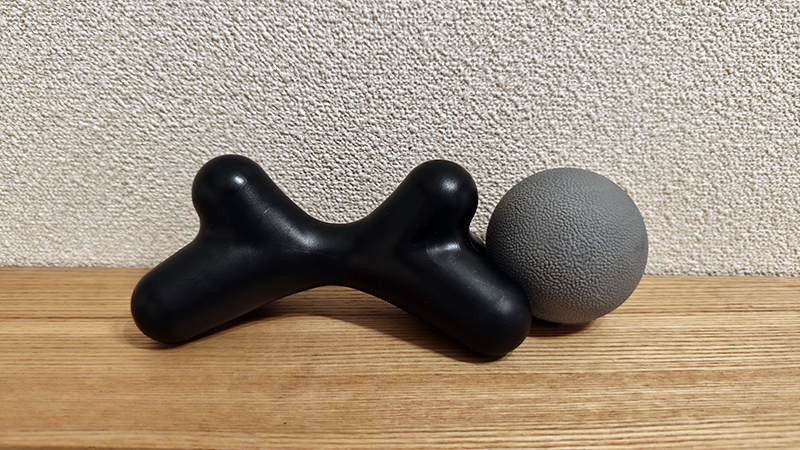
The two items in the photo finally made mornings feel different: an Alphax Koshi Sukkiring Bone and a firm ball that came free with another roller.
The Alphax Koshi Sukkiring Bone—and the free ball that turned out to be useful


I used these around my lower back and the muscles along my back. Over time, my back felt lighter, and I could bend forward again after waking up.
I already owned the regular Alphax lower-back stretcher and its neck version. I’d bought them about five years earlier and used them occasionally.
The regular lower-back version was useful for stretching, but it didn’t give me the focused pressure I wanted. I normally used the neck one around my neck and shoulders. When my back became particularly troublesome, I tried that against my lower back too.
It certainly delivered pressure. Unfortunately, its height also made me arch my back too much, which was uncomfortable. I wanted something lower and more suited to the area, so I bought the Bone.
A friend used a wooden pressure-point tool from Comolife, which I also considered. Reports of it breaking at the base put me off that option.
What was my back actually doing?
I spend a lot of time sitting and don’t exercise much. Walking during my commute is about the extent of it.
When fatigue builds up, my back can feel as though something has taken up residence there. A mixture of stiffness, heaviness, and general unpleasantness.
I’d stretch or use my foam roller, but the roller rarely felt as though it reached what was bothering me. Sometimes I’d do the sort of movements used in Japan’s radio-exercise routines, or try a bridge. Moving around would often make things feel better.
My lower back remained sore, though. I’d lie on my back and pull my knees toward my chest, or do twisting stretches. They didn’t seem particularly effective, but I didn’t have a better idea.
Why were mornings the worst?
Getting out of my futon was a small production. Sitting straight up hurt, so I’d turn onto my stomach, push myself up with my arms, and then stand.
At the sink, bending forward produced a pulling pain deep around my waist. The more I folded forward, the harder it became to hold that position.
I wondered whether the deep hip-flexor area was involved. Rubbing or pressing around it didn’t seem to reach the problem. Back-extension stretches before bed didn’t change the following morning either.
Squatting gave me a stretching sensation despite the discomfort, so I found myself doing that quite often after waking up.
Two weeks with the Bone
When the Bone arrived, I started using it every day. Around my lower back, near the sacrum—the triangular bone at the base of the spine—it gave a very concentrated sensation. The Japanese phrase ita-kimochi-ii, “hurts in a satisfying way,” came to mind.
The Bone has three spacing options. I used the narrower setting lower down and the wider one farther up my back. The surprising part was how much tenderness I noticed even around the middle of my back. Apparently the troublesome area was considerably larger than I’d imagined.
Compared with my roller, this felt much more targeted.
Why didn’t the roller with bigger bumps work better?

My original roller is a TriggerPoint GRID. It has a little give and feels fairly gentle on my back and thighs. I wanted something more focused, so I bought a cheaper roller with much bigger protrusions.
That went in the other direction: too hard and uncomfortable, with such a big difference between the raised and smooth sections that it wouldn’t roll smoothly.
Oh. Of course. That would happen, wouldn’t it?
Nobody seems to mention this. Do people just rock back and forth through a tiny angle on one bump, then move to the next one?
I mostly stopped using that roller. The ball included in the set, however, was excellent. Roughly tennis-ball-sized, with the firmness of a car tire: some spring, but not much squash.
A tennis ball had started feeling too soft for me. This one arrived at exactly the right time.
I found the small contact area much easier to position. With a roller under my middle back, I sometimes ended up holding an almost-crunch position and wondering whether I was relaxing my back or training my abs. The ball was less of a production.
My back felt lighter—and turning became easier
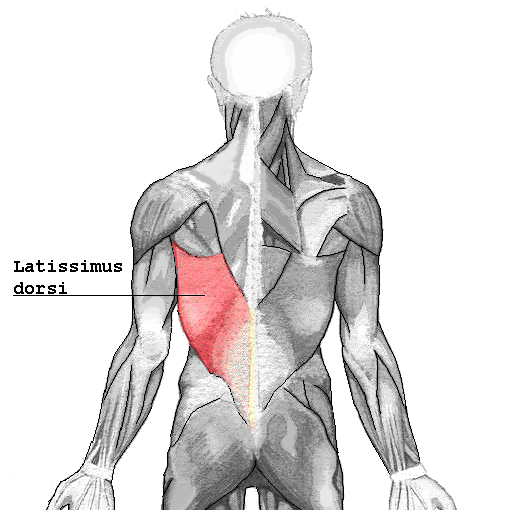
Latissimus dorsi illustration, via Wikipedia
I’d also noticed that I could turn farther to the right than to the left when looking behind me. I’d always shrugged it off: I’m right-handed, perhaps that was just how things worked.
After working around my back, that difference became much less noticeable. Turning felt easier in both directions, and I woke up with less of that heavy feeling.
From the location, I wondered whether the latissimus dorsi—the broad muscles across the back—were involved. Whatever the exact muscle, the change in how easily I could move was an unexpected bonus. I hadn’t even set out to address the uneven twisting.
Then the morning bending pain eased too
Since my back was feeling better, I spent more time using the ball around my lower back. There were several spots near the sacrum where the pressure felt particularly noticeable.
After another couple of weeks, the pain I felt when bending forward in the morning had gone.
I’d also tried positioning the ball toward the front, around the deep area I’d been thinking of as my hip flexors, but that hadn’t done much for me. Working from the back was what seemed to make a difference. I don’t have a neat anatomical explanation for why the pulling sensation at the front eased as well; the useful part was being able to bend again.
My position with the Bone changed as I got used to it. I began lying back and later brought my knees up toward a seated, knees-bent position. With the single ball, I worked on one side at a time. The amount of pressure changes with body weight and position, so I would check the product instructions rather than copy the same posture and assume it will feel identical.
The tools I ended up keeping
For me, a tennis ball felt too soft, a back stretcher wasn’t focused enough, and the Nakayama-style tool didn’t quite have the shape I wanted. The Bone and the firmer ball were the combination I liked using.
The Bone is small and feels stable. A single ball is handy for a particular spot, but working on each side separately takes time. I don’t know whether I’d get two separate balls to stay where I wanted them, so the Bone is the more convenient starting point in my own routine.
The TriggerPoint MB1 below is another massage-ball option. It isn’t the free ball from my roller set:

Now I can lift my legs while lying down and use a little rocking motion to get up in the morning. That sounds like an extremely ordinary achievement. But lifting my legs used to hurt enough that I couldn’t do it.
Being able to get up and wash my face without the whole morning negotiation? I’m very happy to have that back.