How Many Hours Should You Fast Before a Health Check—8 or 10?
How long do you have to stop eating before a health check? Some hospitals say 8 hours, others say 10 or even 12. If your appointment is at 9 a.m., you can finish dinner by 9 p.m.; 11 a.m. slots let you eat until 11 p.m.
But what if your exam is 4 p.m.—does that mean no food after 4 a.m.? I’m still asleep at that point!
Is an 8-hour fast enough?
Looking through clinic pages for “health check fasting hours,” most of them ask for 8–12 hours. That suggests 8 hours is the lower bound.
People with afternoon appointments are allowed breakfast, so those blood draws usually happen 6–8 hours after eating. That backs up the idea that roughly 8 hours is “good enough.”
Can we shorten it?
If you’re told “no food 8 hours before,” it’s tempting to sneak a snack or a coffee. Three items are especially sensitive to pre-test eating:
- Fasting triglycerides
- Fasting blood glucose
- Urine glucose
If we know how long these recover, we know the true cutoff.
Triglycerides
Triglycerides jump the most 3–6 hours after eating, then drop as you metabolize them and roughly return to baseline around the 10-hour mark. Metabolism speed, body type, and meal content all matter.
Triglyceride normal range For accurate measurement, many clinics ask for about 10 hours of fasting before blood draws. 健康診断でよく指摘される中性脂肪!下げるには?コレステロールとの違いは? - 丹野内科・循環器・糖尿病内科ブログ
Fat is the slowest to process—bile works like dish soap’s surfactants to break it up so it can be stored as triglycerides. At 8 hours, absorption is still in flight; more on that in a bit.
Blood sugar
Blood glucose spikes fastest. It peaks around 30–60 minutes after eating and drops back toward pre-meal levels in about 2–3 hours thanks to insulin. Carbs get cleared much quicker than fat.
Urine glucose
Urine glucose follows blood glucose, so it typically settles in 2–3 hours. Fun wording note: Japanese medical docs say “sugar comes down into the urine,” which sounds like glucose is making a dramatic entrance.
| Item | Time until meal impact fades |
|---|---|
| Triglycerides | ~10 hours |
| Blood sugar | 2–3 hours |
| Urine glucose | Follows blood sugar (2–3 h) |
So triglycerides take the longest—about 10 hours. Carbs settle in a few hours. Could we just eat fat-free food 3 hours before and be fine? Not really; extra carbs can still convert into triglycerides (*1) and add noise.
*1 When excess carbs can’t be stored as glycogen, they get converted to triglycerides in fat tissue. 基礎から学ぶ! スポーツ栄養学 P14
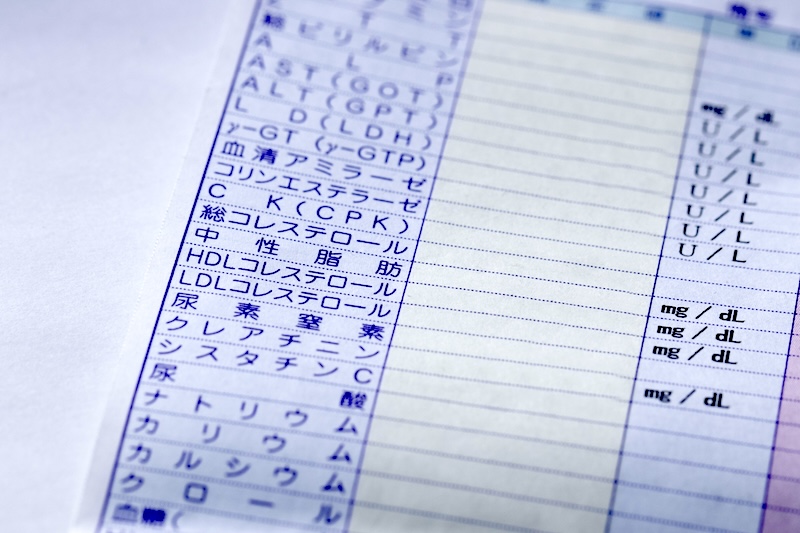
Why do some clinics still allow 8 hours if triglycerides need ~10? Look closely at the report: there are two lines such as “random triglycerides” and “fasting triglycerides.” The fasting number is preferred, but truly empty stomachs are hard to guarantee, and morning fasting is rough for afternoon slots. If you’re not fully fasting, they’ll check the random value instead.
I had an afternoon exam recently and said I ate breakfast at 7 a.m. The staff wrote it down and crossed out fasting triglycerides and fasting glucose on the sheet—so they simply didn’t judge those. That’s why ~8 hours can be “acceptable.”
What about the previous day’s meals?
The above was about the last meal. The day before still matters:
- High-fat meals: Can push up next-morning triglycerides.
- High-protein meals (big meat portions or protein shakes): Can influence kidney markers like creatinine.
- High salt: May raise blood pressure.
If you’re watching triglycerides, kidney function, or blood pressure, stick to lighter, low-salt meals (simple Japanese-style dishes) the day before. Save fried chicken or BBQ for later.
Drinking the day before?
Alcohol affects several markers.
- Liver function (AST, ALT, γ-GTP): Heavy drinking can elevate them, and the effect can last 48–72 hours.
- Uric acid: Alcohol metabolism boosts lactic acid, reducing uric acid excretion; levels can rise for 24–48 hours.
- Triglycerides: Alcohol promotes fat synthesis in the liver, so it often shows up in the next day’s bloodwork.
If these numbers worry you, avoid alcohol for 2–3 days before. Daily drinkers won’t see instant recovery—so continuing to drink defeats the point of the test 🙅♂️.
Exercise the day before?
Light exercise is fine; high-intensity work isn’t recommended.
- Uric acid: Hard workouts raise lactic acid, which can temporarily lift uric acid levels.
- Kidney function (creatinine): Heavy muscle use increases creatinine, which is cleared by the kidneys.
- Liver markers (AST, ALT): Intense muscle load can elevate muscle-derived AST/ALT, risking a false liver flag.
So skip heavy lifting or hard intervals the day before; easy everyday movement is plenty.
- Reference: 尿酸値を変化させる要因 | 公益財団法人 痛風・尿酸財団
- Reference: クレアチニンと筋トレの関係とは?数値が高くなる理由と健康診断への影響 | 赤羽もりクリニック
Quick summary
The safe rule: finish eating at least 8 hours before. Japan’s Ministry of Health guidance says:
a For specific health checks, fasting triglycerides are drawn after 10+ hours of fasting; random triglycerides are drawn after 3.5+ hours and under 10 hours.
c For specific health checks, fasting blood glucose is drawn after 10+ hours of fasting; random glucose is drawn after 3.5+ hours and under 10 hours. 健診作業班における主な変更点
In my case, I ate at 7 a.m. and had the draw within 10 hours, so they skipped the fasting values.
Best meal timing
Morning appointments
- Finish dinner by 9–11 p.m. the night before.
- Fasting triglycerides can be measured (recommended).
Afternoon appointments
- Light breakfast by 8 a.m.
- Fasting triglycerides can’t be measured; they’ll use random values.
Day-before tips
- Alcohol: avoid for 2–3 days (affects liver enzymes and uric acid).
- High-fat meals: skip (affects triglycerides).
- Hard workouts: skip (affects creatinine and uric acid).
If you want the most precise numbers, book a morning slot. Just know everyone wants those, so they’re hard to grab.